










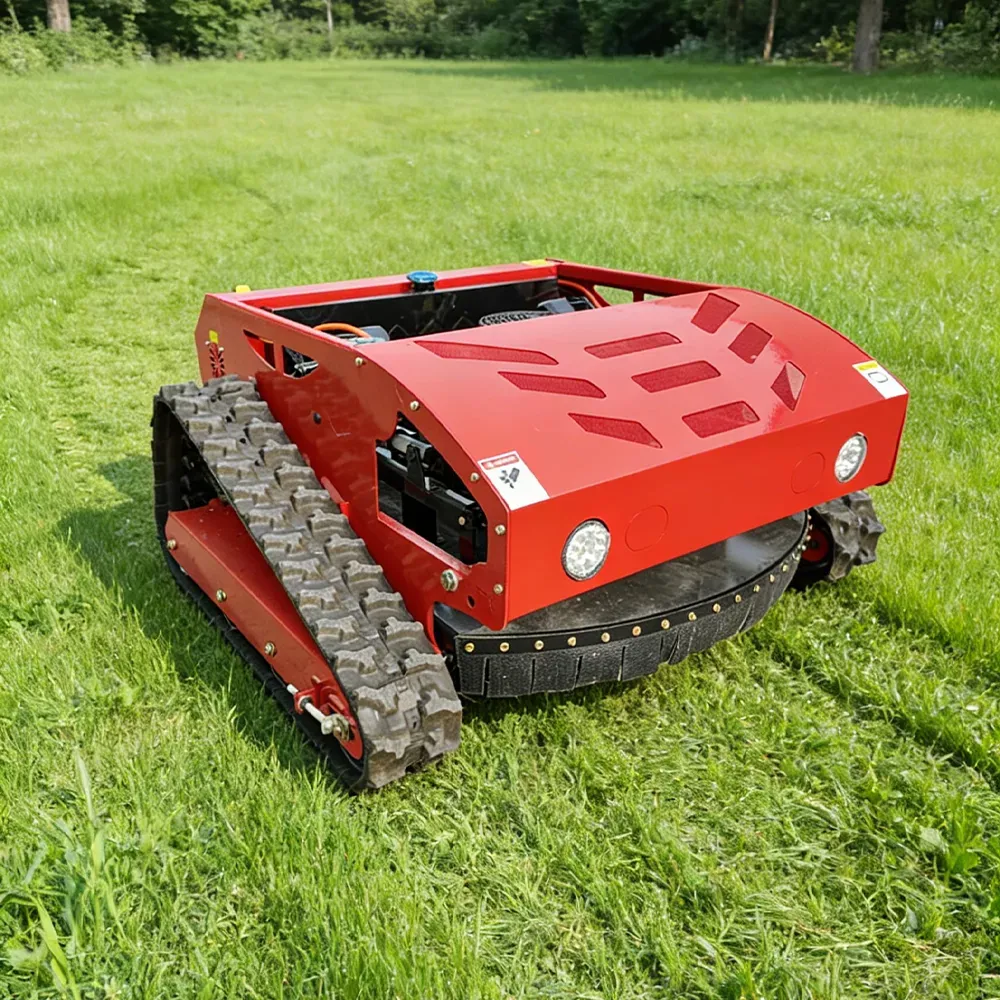
Remote Control Lawn Mower
The operator stays off the slope — the machine doesn't · Tracked RC mowers, rotary & flail
Our remote control lawn mowers put a rubber-track chassis under the cutting deck and a radio transmitter in the operator's hands, so the machine works the bank while the crew stands on firm ground. Three series cover the work: the 600/800 rotary-deck line with a 608 cc gasoline engine, the 80/100/120 flail series running a Loncin 459 cc, and the heavier 800S/1000S line with an EU5-certified 452 cc engine plus a diesel option. Municipal contractors, solar O&M crews and dam authorities buy them by the container; CE marking and OEM customization are part of the standard offer.
Models & technical data
| Series | Engine (as photographed) | Cutting head | Drive / chassis | Cutting width | Gradeability |
|---|---|---|---|---|---|
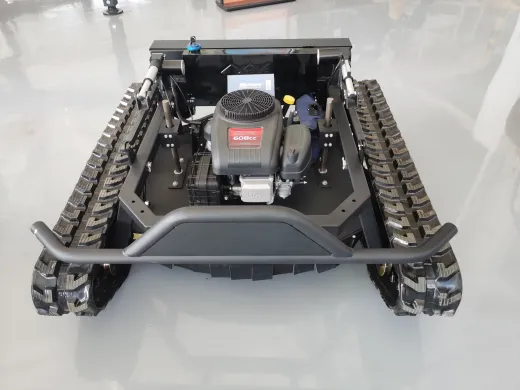
| 600 / 800 | 608 cc gasoline | Rotary blade deck, protective plate | Rubber tracks, anti-collision bar, electric deck-height actuators | 600 / 800 mm | 45° |
| 80 / 100 / 120 | Loncin 459 cc gasoline | Flail / straw-crusher head, belt drive | Rubber tracks, roll frame, onboard console (power display, engine start) | 800 / 1,000 / 1,200 mm | 45° |
| 800S / 1000S | Loncin 452 cc gasoline (EU5); diesel option | Rotary deck with chain-curtain guard; flail & blade attachments | Triangular reinforced rubber tracks, guide wheels, height-adjustment bolts | 800 / 1,000 mm | 45° |
The table reflects the photographed machines; cutting widths follow each series' model numbering and the 45° rating is the design slope limit. Remote range and weights, plus the exact build, are confirmed per model — full data sheets on request.
Watch it work
Key features
- Three series from one factory — 600/800 rotary deck, 80/100/120 flail, 800S/1000S heavy line
- Engines as photographed: 608 cc gasoline, Loncin 459 cc, and EU5-certified 452 cc with a diesel option
- High-tooth rubber tracks — triangular reinforced profile on the 800S — for grip on wet banks and loose ground
- Interchangeable working heads: rotary mowing deck, flail / straw-crusher head, dozer or snow blade
- Industrial radio remote keeps the operator off the slope; emergency-stop button on the chassis
- CE marked, 93 dB noise label on the flail series; quenched alloy-steel hammer blades
- OEM logo and color customization supported for importers and dealers
Where it works
Why crews are switching to remote control slope mowers
Steep banks are where ride-on mowing accidents happen. A remote control slope mower takes the operator out of that equation: the machine hugs the embankment on rubber tracks while the driver stands at the top with a radio transmitter. Rollover exposure stops being a personnel risk and becomes a maintenance question.
The chassis is the point. A tracked mower spreads its weight over a long footprint, so where a wheeled hillside mower spins and slides on wet grass, a tracked mower keeps pulling. The engine sits low in the frame, the deck hangs between the crawlers, and the 800S series adds a triangular reinforced track profile for loose or rutted ground. That geometry is why steep slope mowers in this class are tracked, not wheeled.
One distinction worth a sentence: a zero-turn with tracks is still a ride-on machine built for flat-turf speed, while these carry no seat at all — the operator never leaves stable ground. If your work is flat turf, buy the ride-on; if it involves banks and ditches, keep reading.
Rotary deck or remote control flail mower — pick by vegetation
For maintained turf — parks, verges, lawns around public buildings — the 600/800 rotary deck is the right head. Its 608 cc engine drives a conventional blade under a protective plate, and electric actuators adjust cutting height from the remote. The result reads like a mower cut, not a brush-clearing pass.
Heavy growth is different work. The 80/100/120 series mounts a flail / straw-crusher head with quenched alloy-steel hammer blades, which is what buyers after a brush cutter or bush hog actually need: it shreds brambles, ditch weeds and crop residue instead of wrapping them around a blade spindle. A flail head also throws less debris — useful beside roads.
The 800S/1000S line accepts both logics, plus a dozer/snow blade, so one chassis earns its keep across seasons. Its chain-curtain guard keeps clippings and stones down around the deck, height-adjustment bolts set the cut where you need it, and guide wheels hold track alignment through long shifts.
Where export buyers actually run these tracked mowers
Municipal and landscaping contractors put the rotary models on roadside verges and green belts, where a remote control mower on tracks works the ditch bank that a ride-on has to skip. Solar O&M companies are the fastest-growing buyer group: vegetation under and between panel rows shades output and raises fire risk, and a low remote mower reaches where tractors cannot.
Dam and irrigation authorities mow levee embankments on a fixed schedule, which is exactly the repetitive, high-risk job a remote machine should own. Orchard and vineyard operators run the flail versions between tree rows, cutting grass and mulching prunings in one pass.
Buying remote control lawn mowers at factory level
We build these machines in Jining, Shandong, and ship them export-packed in plywood crates — singly, palletized, or mixed into a container with our crawler carriers and other equipment. Stock units are photographed in our workshop, not rendered; what you see on this page is what gets crated.
For dealers and importers, OEM logo and color customization are supported across the range, and dual remote-control options (industrial-grade or standard transmitter) are confirmed at order time. Send your target spec — slope profile, vegetation type, cutting width — and we return the matching model sheet and a commercial quotation, usually within a working day.
The Remote Control System Itself
The transmitter is an industrial radio unit, not a hobby-grade toy controller — built for interference resistance around power lines and solar arrays, with a range sized to keep the operator well clear of the slope being cut. An emergency-stop button on the chassis and on the transmitter cuts power instantly if the machine loses traction or the operator needs to intervene.
We offer both industrial-grade and standard transmitter options depending on the site — a solar farm with dense rows of panels or a dam with radio interference from other equipment usually calls for the industrial-grade unit. Training an operator takes an afternoon rather than a season: there's no seat to learn, no clutch, just throttle, steering and head engagement on a handheld control.
Electric, gas, petrol and battery-operated options
All three series run on gasoline: 608 cc on the 600/800 rotary line, a Loncin 459 cc on the 80/100/120 flail series, and an EU5-certified Loncin 452 cc on the 800S, with a diesel option for buyers who run unified diesel fleets. Gasoline is what most commercial operators choose for runtime and refueling simplicity in the field.
Electric and battery-powered tracked slope mowers at commercial scale are an active development area for us, not something in production yet. If a quiet, noise-sensitive site — hospital grounds, residential areas, a national park — is a hard requirement, tell us the duty cycle and we'll say plainly what's currently available rather than promise something that isn't ready.
Steep hills, hillside banks, ditches and all-terrain work
The 45° gradeability rating is the number worth comparing against any competing machine — it's the design slope limit across all three series, driven by the low center of gravity and long track footprint rather than raw engine power. On a ditch or bank job, track gauge and turning radius matter as much as the slope rating: the machine needs to fit between guardrails or clear water at the bottom of a cut without extra margin to spare.
Whether a mower handles both the face and the back of a berm in one pass comes down to whether the cutting head floats on the downhill side — the flail series does this better than a fixed rotary deck, which is one reason contractors buy one of each for embankment work. For genuinely mixed, crawler-accessible terrain, a four-point traction chassis is worth a separate conversation.
We're direct about the limits: loose shale above 45°, submerged ground and actively eroding banks are outside the design envelope, whatever a spec sheet elsewhere claims. Tell us the slope degree, surface type and vegetation and we'll confirm the right series — or say plainly that a tracked mower isn't the right tool for your site.
Remote control mower price, cost and buying guide
Price is a genuine range, not a single number — a rotary-deck model costs less than an 800S heavy-line flail, and the gap widens with options like a diesel engine, a dual-head kit or OEM branding. We quote FOB Shandong per model sheet, with no trading-company margin on top.
Buying through a marketplace listing or a trading company usually means paying for their margin and their guesswork on the exact engine and spec. We're the manufacturer, so a quote from us references this page's machine, with the model number, engine and shipping weight confirmed on the proforma invoice rather than a ballpark figure.
We can also quote a chassis without the cutting head, or a head shipped separately as a spare or replacement. If you have a model code from a prior quotation or a competitor's datasheet, send it over and we'll cross-reference it against our current production range.
RC remote mowers vs robotic mowers, zero turn and walk-behind — honest comparison
A true robotic mower runs autonomously on a boundary wire or GPS fence with no operator input during the mow. A remote control mower needs a human holding the transmitter the entire time. Both keep the operator off the slope, but they solve different problems — a robotic mower suits large, flat or gently rolling ground with no variable obstacles; a manually operated machine is the right call for irregular embankments, ditches and sites where a human needs real-time judgment.
A remote control zero-turn is a different chassis altogether — wheeled, built for flat-turf speed, and it still carries a seat even in remote-control conversion kits. A walk-behind remote mower sits in between: the operator walks rather than rides, so the safety benefit is partial. Our crawler machines have no seat and no wheels — they're purpose-built slope mowers. If your site is flat turf, a zero-turn wins on speed; if it has banks, ditches or embankments, the tracked crawler is the right tool and the zero-turn is not.
Related Buying Guides
Best Mower for Steep Slopes and Hills: How to Choose Safely
Finding the best mower for steep slopes, hills, and banks — from push mowers and riding mowers to tracked zero-turn conversions and remote-control slope mowers. Safety grades, robot mower limits, and what commercial operators actually use.
Read more →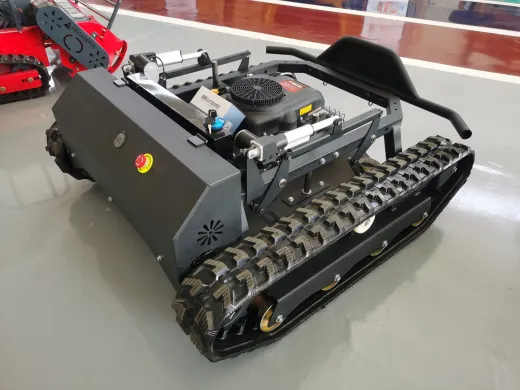
Remote Control Mowers for Solar Farms, Levees and Slopes
A remote control slope mower handles solar sites, river levees and steep embankments that crews can't safely walk. Here's how flail decks, tracks and control range fit commercial vegetation management.
Read more →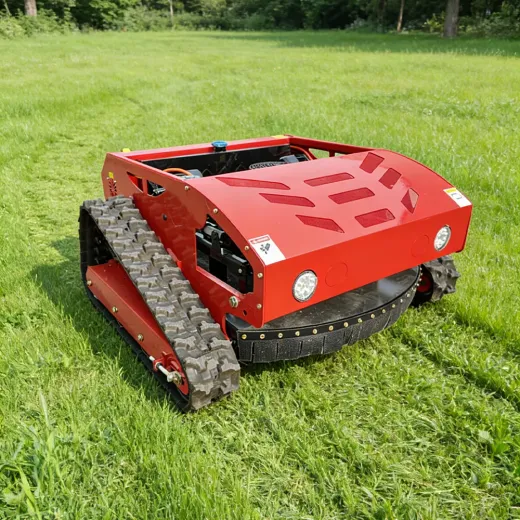
DIY RC Lawn Mower: Build vs Buy — What Actually Makes Sense
Thinking about building a DIY RC lawn mower? We break down every component, the Arduino approach, real costs, build time, and the safety risks most guides skip — so you can decide whether to build or buy a commercial remote control mower.
Read more →Common questions
How steep a slope can a remote control slope mower handle?
It depends on the model, track condition and whether the grass is wet, so we quote gradeability per machine rather than print one number for the range. The design intent is clear though: low center of gravity, long track footprint and no operator on board, for banks where ride-on mowing is already unsafe. Tell us your slope profile and we will confirm the right series.
What is the difference between a remote control flail mower and a rotary deck model?
A rotary deck gives a clean, lawn-quality cut on maintained turf — that is the 600/800 series. A flail head carries dozens of hammer blades that shred heavy weeds, brambles and crop residue without wrapping, and throws less debris — that is the 80/100/120 series. Many buyers take one of each per container.
Where can I find a heavy-duty remote control lawn mower for sale at factory price?
Directly here — we are the manufacturer, not a trading company. You order against the model sheet, we build, photograph and crate the machines, and you save the middleman margin. MOQ is flexible: single sample units go out by plywood case, and mixed containers with our other equipment are common for first orders.
Do you support OEM branding on rc mowers?
Yes. OEM logo and color customization are supported across all three series, which is how several of our dealer customers sell these machines under their own brand. Decals, body color and remote-transmitter choice are fixed at order confirmation; lead time is quoted with the proforma invoice.
Which engines power these remote control mowers?
What we photograph is what we ship: a 608 cc gasoline engine on the 600/800 rotary series, a Loncin 459 cc on the 80/100/120 flail series, and an EU5-certified Loncin 452 cc on the 800S — with a diesel engine option for buyers who run diesel fleets. Engine choice is confirmed per order.
Can a tracked mower work under solar panels?
Under-panel mowing is one of the most common uses our buyers report. The machine's deck rides low and the operator steers it down the row by remote, so panel clearance — not operator headroom — is the only constraint. Send your panel height and row spacing and we will confirm which models fit your site.
What does a remote control lawn mower cost, and how do I get a price?
Remote control lawn mower price varies by series, engine spec, head type and order quantity. A single rc mower price quoted FOB Shandong is always lower than the same machine through a trading company or marketplace. We quote per model sheet within one working day — send us your slope angle, vegetation type, preferred cutting width and destination port. That is everything we need to return a firm remote control slope mower price, not a ballpark.
Is there an electric or battery-operated remote control lawn mower?
Our current production range runs on gasoline or diesel — a gas powered remote control lawn mower or remote control petrol lawn mower is what most commercial operators choose for runtime and refueling simplicity. Electric remote control lawn mower and battery operated remote control lawn mower options are in active development for noise-sensitive sites. If an electric or cordless remote lawn mower is a hard requirement, contact us with your duty cycle and we will confirm what is currently available rather than overpromise.
What is the difference between an RC mower and a robotic lawn mower?
A remote control mower requires a human operator holding a transmitter at all times; a robotic lawn mower runs autonomously on a boundary wire or GPS fence with no continuous operator input. Both keep the operator off the slope, but a robotic mower suits uniform, obstacle-free areas while an RC mower handles irregular banks, ditches and variable terrain where real-time human judgment matters. If you see listings for a remote control robot lawn mower or robotic remote control mower, read the specification carefully — those terms are often used interchangeably but describe different operational models.
Can I get a remote control zero turn mower instead of a tracked mower?
A remote control zero turn mower is a fundamentally different machine — wheeled, seat-equipped, optimized for flat turf speed. Our tracked crawler mowers carry no seat; the operator never mounts the machine. For flat open turf a zero turn is faster and more cost-effective. For banks, embankments, ditch lines and hillside work, a tracked remote mower is the correct tool and a wheeled zero turn is not — it will slide on any meaningful grade.
Can your remote control mower act as a remote control brush hog or remote brush cutter?
Yes — the 80/100/120 flail series is exactly what buyers mean when they search remote control brush hog, remote bush hog, remote brush mower, remote control brush mower or remote brush cutter. Its hammer-flail head shreds heavy brush, brambles and woody stems that would stall or wrap around a rotary blade. The 800S with a flail attachment covers the same heavy-vegetation application at a wider cutting width. A remote control brush cutter on tracks, remote control brush cutter or remote flail mower search all point to the flail series as the correct answer.
What is the rm6025 45 or rc 318t model code?
The rm6025 45 code refers to our 600-series rotary-deck model with a 45° rated gradeability — the '60' indicates the 600 mm cutting width and '25' is an internal production batch identifier. The rc 318t designation appears in some regional distributor catalogues and maps to the 800S tracked series. If you have a model code from a prior quotation or a competitor's datasheet, send it and we will cross-reference against current production.
Do you sell remote control mower kits, or just complete machines?
Complete machines are the standard order. However, we can quote a remote control mower kit — chassis only without the cutting head, or a head assembly as a spare or replacement — for buyers who want to mount a specific attachment or replace a worn head without replacing the whole machine. A remote controlled lawn mower kit or rc lawn mower kit in the aftermarket sense — converting an existing mower to remote control — is not something we support; these are purpose-built machines, not conversion kits.
Request pricing for the Remote Control Lawn Mower
Send your target model, quantity and destination port. Our export team replies within one business day with a quote, lead time and shipping details.
- Phone / WhatsApp: +86 182 5478 8200
- Email: [email protected]
- Jining, Shandong, China