










Skid Steer Attachments
One carrier, twenty tools · 20 quick-attach tool types
A skid steer carrier earns its keep through what you bolt to it. Our catalog covers 20 skid steer loader attachments on a universal quick-attach plate: earth augers, a trencher and a backhoe arm for digging; a hydraulic breaker for concrete; pallet forks, a bale spear, grapples and 4-in-1 buckets for handling; brooms, a mower and a full snow package for grounds work. Hydraulic tools connect through quick couplers on the carrier's auxiliary circuit. We supply the attachments from the same Jining factory as the loaders, so plate fit and oil flow are matched before anything goes in the container — see our skid steer loaders if you still need the carrier.
Models & technical data
| Attachment | Typical job | 380 mini | S55 wheeled |
|---|---|---|---|
| Standard / high-dump bucket | Dirt, gravel, backfill | ✓ | ✓ |
| 4-in-1 combination bucket | Doze, grab, level, backfill | ✓ | ✓ |
| Earth auger | Post holes, footings, tree pits | ✓ | ✓ |
| Hydraulic breaker | Concrete and rock demolition | ✓ | ✓ |
| Pallet forks | Pallets, lumber, pipe | ✓ | ✓ |
| Bale spear | Hay and silage bales | ✓ | ✓ |
| Angle broom / sweeper-collector | Roads, lots, floors | ✓ | ✓ |
| Trencher | Utility lines, irrigation | ✓ | ✓ |
| Log grapple | Brush, logs, demolition debris | ✓ | ✓ |
| Dozer blade | Pushing and rough grading | ✓ | ✓ |
| Mower / brush cutter | Grass and light brush | ✓ | ✓ |
| Snow package (blade, V-plow, blower, bucket) | Winter maintenance | ✓ | ✓ |
Pairing guide: '✓' is a standard catalog pairing we photograph and ship; 'on request' means we confirm plate size and hydraulic flow against your carrier before quoting. Third-party carriers with a universal plate are checked the same way.
Key features
- 20 attachment types in the standard catalog, all on one universal quick-attach plate — quick attach skid steer attachments, not bolt-on adapters
- Hydraulic tools — breaker, auger, trencher, snow blower — run off the carrier's auxiliary couplers
- Five bucket styles: standard, 4-in-1 combination, high-dump, screening and snow
- Pallet forks and bale spear cover yard, warehouse and farm handling
- Angle broom and angled sweeper-collector for roads, lots and warehouse floors
- Sized for stand-on minis up to 890 kg rated-load wheeled loaders
- Attachments crate and ship together with the carrier — one container, one QC, one invoice
Where it works
Dig, Drill and Trench
The auger is the post-hole digger of the lineup: a hydraulic drive head with interchangeable bits for fence posts, footings and tree pits. One operator drills in seconds what a crew with hand augers fights all morning. We photograph it mounted on the S55 — drive head, extension and bit ship as a set.
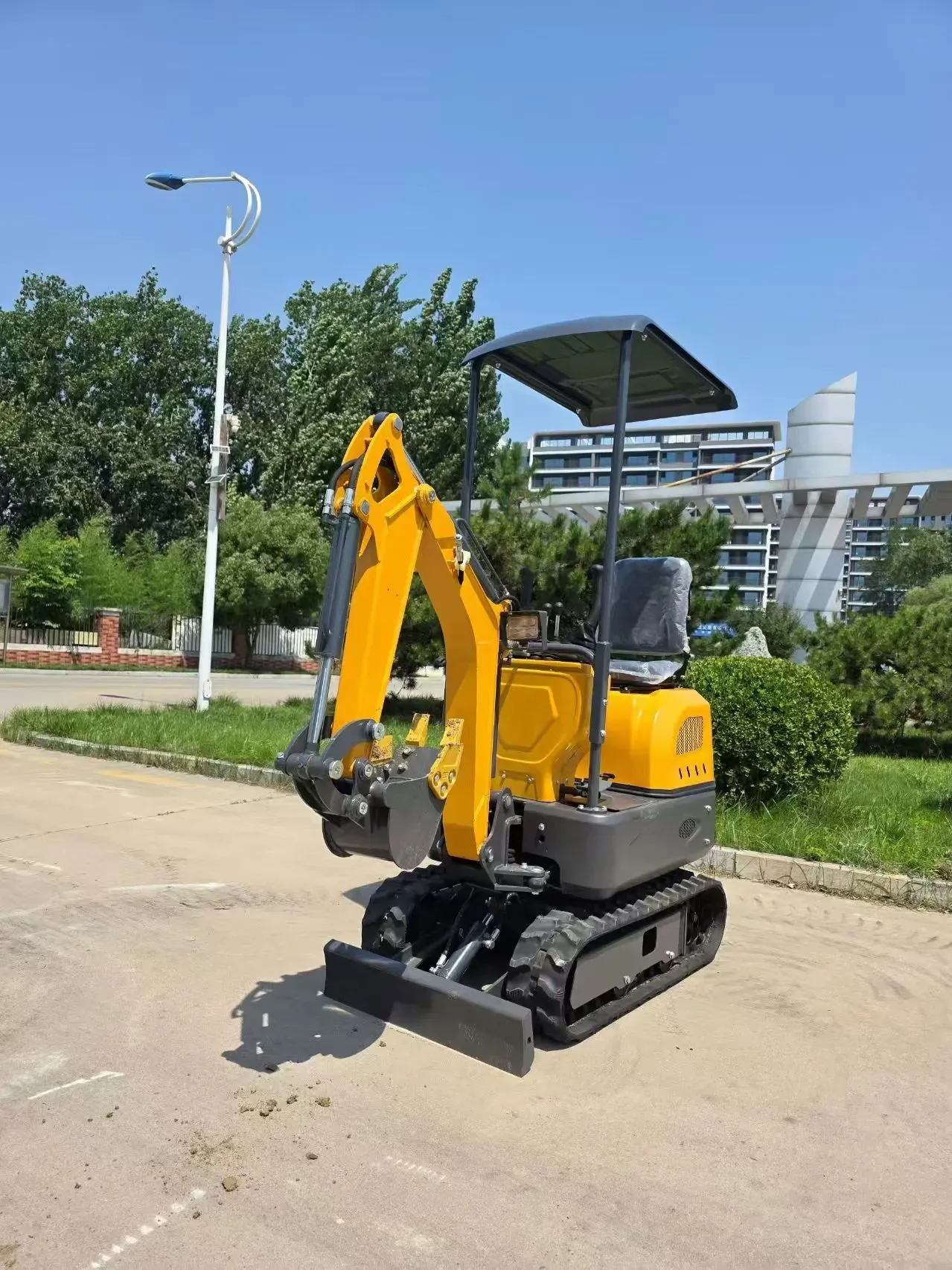
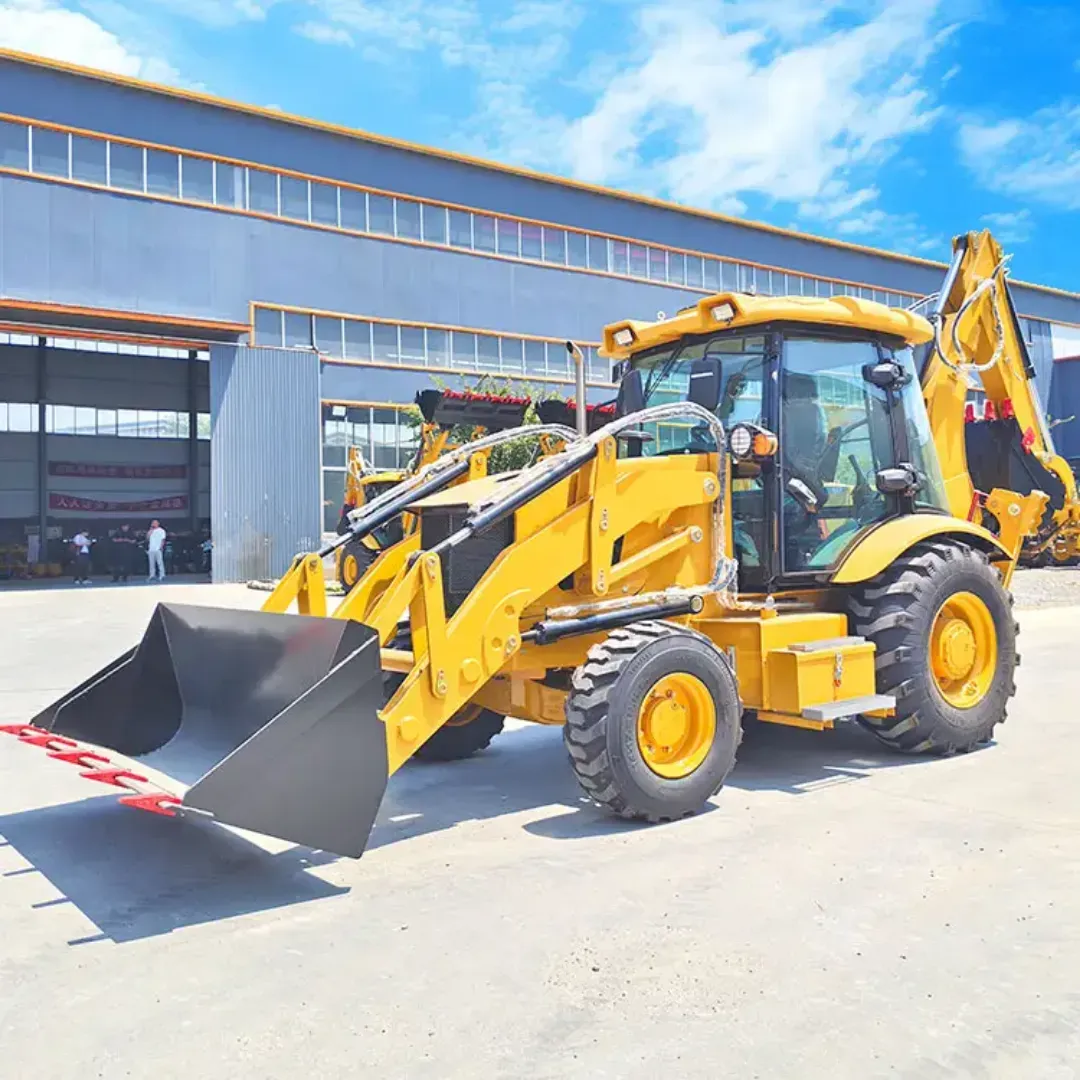
For linear work there is a trencher for irrigation and cable runs, and a backhoe arm that turns the carrier into a spot excavator for stumps and pits. Neither replaces a dedicated excavator on volume digging; both earn their freight on mixed jobs where hauling a second machine costs more than it returns.
Break, Grab and Sort
The hydraulic breaker mounts on the mini carriers for slab demolition, rock and curb work — the photos on this page show it plumbed and working. Because the tracked 380 puts little weight on the ground, it can break a floor inside a building that a heavier rig could never enter.
Handling tools follow: a log grapple for brush and demolition debris, and the 4-in-1 combination bucket that opens to doze, grab, level and backfill without leaving the seat. A screening bucket rounds it out, separating topsoil from rock so fill gets reused instead of trucked away.
Carry, Sweep and Mow
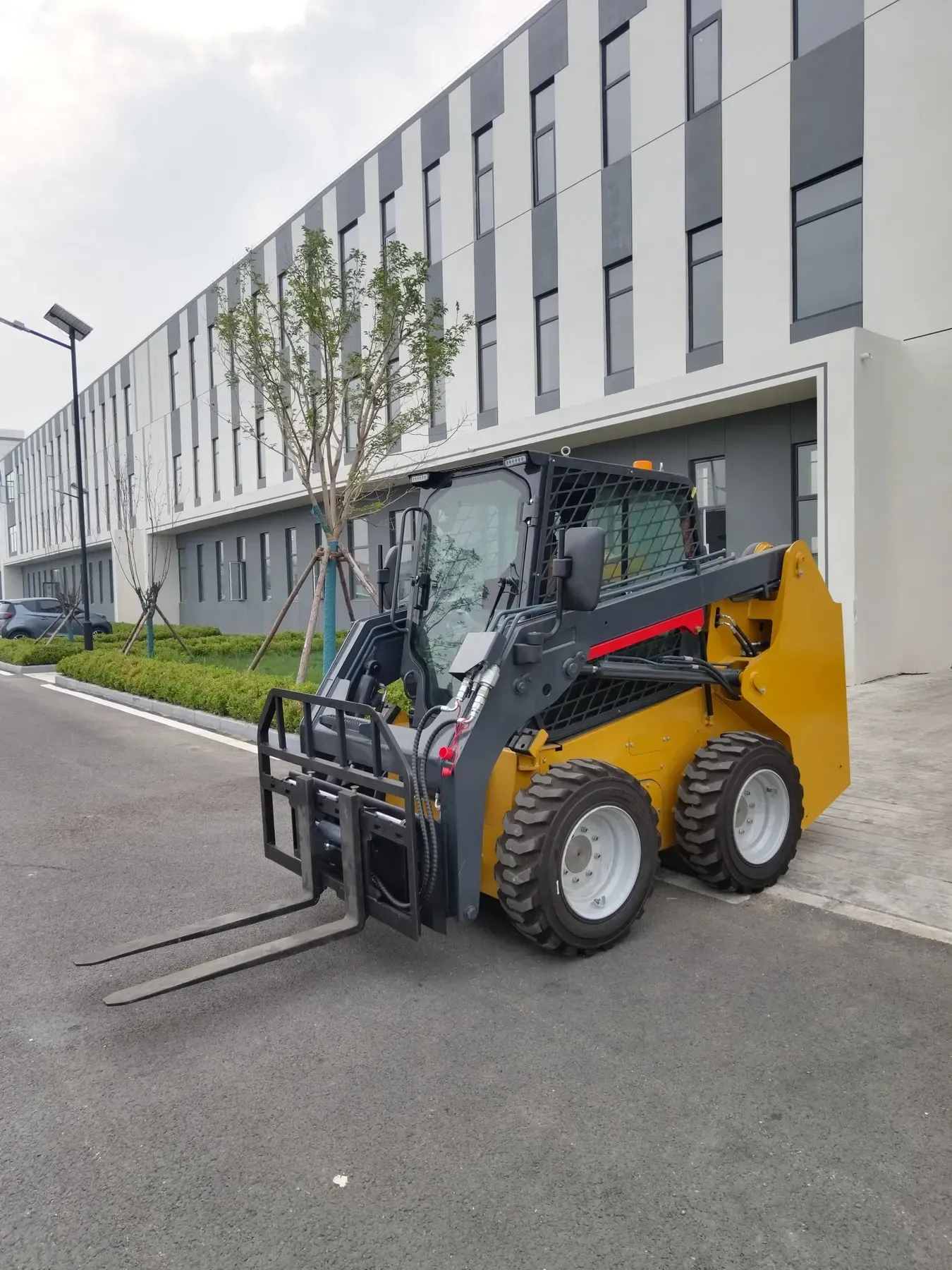
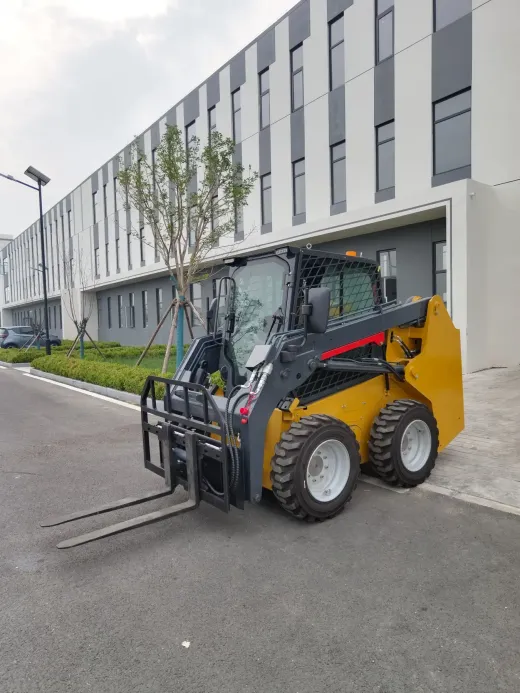
Pallet forks turn the carrier into a rough-terrain forklift for pallets, lumber and pipe; the bale spear does the same job for hay. Both are fixed-tine, no hydraulics to connect — drop them on the plate and drive.
For grounds keeping there is an angle broom and an angled sweeper-collector for lots and warehouse floors, plus a flail-type mower for grass and light roadside brush. The high-dump bucket adds reach when loading high-sided trucks with mulch or grain.
These attachments pair with the carriers on our skid steer loaders page — the stand-on 380 and the wheeled S55 — and with most third-party machines that carry a universal plate. Send your plate dimensions if the carrier is not ours.
The Snow Package
Four tools cover winter: a straight snow blade for driveways, a V-plow that splits deep drifts, a snow blower that throws rather than piles, and a wide snow bucket for stacking. Contractors who sweep lots in summer often run the same carrier year-round on this rotation.
Hydraulic units like the blower take the carrier's auxiliary flow through the same quick couplers as the breaker, so the changeover between tools is a pin-and-coupler job measured in minutes. Quote the package together with the carrier and it crates in the same container.
Skid Steer Forks & Material Handling Attachments
Pallet forks are the most-ordered attachment after buckets, and it's easy to see why: no hydraulic hookup, just drop them on the plate and drive. The catalog runs standard 48-inch and 60-inch tine sets, plus a quick-attach carriage for fast tool changes between forks and other tools. A grapple-fork option adds a clamping top beam for loose loads — pipe, brush, scrap — that plain tines can't secure.
Farm and ranch orders usually add a bale spear alongside the fork set. A single or double spike penetrates round and square bales cleanly, and the quick-attach mount makes it a fast swap from forks. For yards handling both loose hay and wrapped bales, a bale grapple is the better call — it closes around the whole bale without a center spike, which matters on net-wrapped silage where a spear tears the wrap. A wider grapple with side tines is available on request for square bale stacks.
Rotating forks tilt the load without repositioning the carrier — useful on uneven ground or when loading a truck bed at an angle. A hydraulic version runs tine spread off the auxiliary circuit instead of a manual adjustment. The same geometry is built smaller for stand-on mini carriers; send us your carrier model and we match the plate width and tine capacity before the order goes to the cutting table.
Skid Steer Logging & Grapple Attachments
Grapple attachments grab and carry what buckets and forks can't — brush piles, cut logs, demolition debris, root balls. Our log grapple is a four-tine wrist-action design; a rotating version adds a full 360-degree slew so the operator can load a truck from any approach angle without repositioning the carrier. The grab holds the log while the machine reverses, rather than pushing it along the ground the way a bucket would. A smaller frame covers the stand-on mini carriers.
Root and brush grapples are the land-clearing tools: the wide-set tines on a root grapple reach into rubble and root balls that a log grapple would bridge over, while a lighter, wider-jawed brush grapple handles volume — cut brush, limbs, light demolition debris. For forestry and right-of-way work we often ship a grapple together with a shear attachment that cuts stems at the base while the grapple carries the material to the pile.
A hydraulic log splitter is a less common option, useful on properties that process their own firewood. It runs off the carrier's auxiliary circuit to drive a splitting wedge, and a combination version pairs the splitter with a small crosscut bar. We size the cylinder to your carrier's hydraulic pressure and flow before building it — an undersized cylinder will stall on knotty wood or cavitate the pump.
Skid Steer Tiller & Soil Preparation Attachments
A rotary tiller turns the carrier into a powered cultivator for seedbed prep, garden renovation and athletic field maintenance. It runs off the auxiliary hydraulic circuit and uses a rotor with hardened L-blades that break compacted soil in one pass. The hydraulic drive holds a steady rotor speed regardless of ground resistance — a chain-drive tiller bogs down the moment it hits clay. We match rotor width and blade pattern to the carrier's flow rate before quoting.
Harley rakes and power rakes are finishing tools, not deep tillage. A Harley rake uses spring-tine fingers on a reel to pull rocks and debris to the surface while leaving fine soil ready for seeding — the standard choice for lawn establishment and erosion repair. A power rake does similar work with a paddle-style reel and suits road-shoulder grading and gravel-lot leveling. Where the ground has embedded rock that would bend standard tines, a carbide-tipped soil conditioner is the tool built for it.
Disc plows and harrow attachments round out the range, mainly for small farms running one carrier across both earthmoving and crop ground. A 3-point hitch adapter lets the same carrier run tractor-style implements, and a PTO adapter converts the auxiliary hydraulic circuit to a mechanical shaft output — we confirm the hydraulic flow requirement against your implement before quoting the adapter plate.
Screening Bucket & Rock Separation Attachments
A screening bucket separates fine material from oversize: tilt it back, a drum on the auxiliary circuit rotates, dirt and topsoil fall through the screen bars while rock, roots and debris stay in the shell for a separate dump. Set against renting a standalone trommel screen, the attachment costs less to move and needs no power source beyond the carrier already on site.
It earns its keep on topsoil recovery, compost processing, gravel sorting and turf renovation — anywhere pulling stones before seeding saves real hand labor. A rock bucket, sometimes called a skeleton bucket, is the simpler alternative: fixed tines at fixed spacing, no hydraulics, dirt falls through by gravity as you tilt. It's more durable on abrasive material and costs less, but the bar spacing can't change; the screening bucket's rotating drum lets you tune throughput to the material. We quote screen diameter and bar spacing to the application rather than a fixed catalog size.
Mini Excavator Attachments
Mini excavator attachments extend a compact machine well past digging. The auger is the most-ordered add-on: a hydraulic torque head with interchangeable bits for fence posts, footings, tree planting and pier holes. We size the drive head to the carrier's auxiliary flow and confirm torque output before shipping — the same geometry scales down for the smaller 1-ton class machines.
Hydraulic breakers are the second most-ordered tool. We ship the moil point, body, hose kit and side brackets as a matched set sized to the carrier model, from full mini-excavator classes down to the sub-1.5 t range.
A hydraulic thumb grabs boulders, roots and debris that a plain bucket can't retain — useful on demolition and land-clearing jobs. The bucket lineup covers standard digging, ditching and rock buckets across the size range. Beyond those, we also supply a compaction wheel, a trencher, and a quick-hitch system that makes swapping between tools a one-person job, along with rubber tracks and final drives as wear-and-replacement parts for the carrier itself.
Skid Steer Attachment Types, Brands & Buying Guide
The full catalog covers more ground than buckets and forks: a mulcher and brush cutter for vegetation management, a stump grinder and boom attachment for utility and tree work, a combination bucket for grab-and-scoop jobs, and a grading attachment for finish work. Hydraulic tools are matched to the carrier's circuit — most of our range runs on standard 15–25 gpm flow, with a high-flow option for mulchers and high-torque augers that need more.
We build to the universal quick-attach spec, so plate fit checks out against the major carrier brands — Bobcat, Caterpillar, Case, John Deere, Kubota, New Holland — before anything ships; we confirm against your carrier's documentation rather than assume. Mini carriers vary more between manufacturers, so we ask for a plate drawing or model number on sub-1 t machines.
On price: new versus used comes down to what's hydraulic and what isn't. Used mechanical tools — forks, buckets, blades — are low risk if the tines are straight and the welds are sound. Used hydraulic tools carry more risk: worn seals and undersized motors from a mismatched carrier are hard to spot without pulling them apart, and factory-direct new pricing is often competitive once duty and freight are counted. The right tool for a job isn't a ranking — an auger earns more per hour on a fence-post job, a bucket earns more on a landscaping job. Tell us the work and we'll help build the right set rather than sell the biggest-ticket item on the page.
Related Buying Guides
The Best Skid Steer Attachments, Ranked by What They Earn You
A working list of the best skid steer attachments — grapple, auger, mulcher, brush cutter, trencher, post driver, tiller, box blade, breaker, and more — covering every tool category with sizing, flow, and buying guidance so you know exactly which ones pay for themselves on your jobs.
Read more → Skid Steer Snow Attachments: Blowers, Plows, Pushers & Snow Tracks
Choosing the right skid steer snow attachments can mean the difference between a profitable winter season and a machine sitting idle. This guide covers every major attachment type — blowers, plows, pushers, and snow tracks — so you can match the right tool to your job site conditions.
Read more → Skid Steer Boom & Jib Attachment: Lifting, Tree Moving & Man Baskets
A skid steer boom attachment transforms your compact loader into a versatile lifting machine capable of hoisting materials, moving trees, and elevating workers safely. This guide covers every boom type — from fixed jib poles to telescopic and truss booms — so you can choose the right tool for your job site.
Read more → Skid Steer 3-Point Hitch Adapter: Hitches, Couplers & PTO Options
A skid steer 3 point hitch attachment unlocks a vast library of tractor implements for your loader, from finish mowers to tillers and post drivers. This guide covers every coupler, receiver, and PTO option so you can match the right adapter to your machine and workload.
Read more →Common questions
Will your attachments fit my existing skid steer?
If it carries a universal quick-attach plate, very likely yes. Send a photo of your plate, its width, and the carrier's auxiliary hydraulic flow; we check fit before quoting instead of finding out at your port. Mechanical tools like forks only need the plate to match.
What hydraulic flow do the breaker and auger need?
It depends on the motor we fit, which is the point — we size the breaker, auger or blower motor to your carrier's circuit rather than sell one spec to everyone. Our S55 supplies 55 L/min at 21 MPa, and the catalog tools are matched to it and to the smaller 380.
Do you make a forestry mulcher attachment for skid steers?
The catalog mower is a flail type for grass and light brush, and we will not label it a forestry mulcher — true mulching heads need high-flow hydraulics that compact carriers rarely supply. If your job is genuine forestry work, tell us the carrier and we will confirm honestly what fits.
Can I order attachments in the same container as the loader?
Yes, and it is the cheapest way to buy them. Buckets nest, forks and blades strap flat, and hydraulic tools crate beside the carrier. One container, one quality check, one invoice. The carriers themselves — the stand-on 380 mini and the wheeled S55 — are on our skid steer loaders page.
Which bucket should I choose — standard, 4-in-1 or high-dump?
Standard for plain dirt and gravel; it is the lightest and cheapest. The 4-in-1 combination bucket earns its premium when one machine must doze, grab and backfill in a day. High-dump suits loading tall truck boxes with light material. Many buyers take a standard plus one specialist.
Do you supply snow removal attachments for skid steers?
Yes — straight blade, V-plow, snow blower and snow bucket are all catalog items on the same quick-attach plate. The blower needs the auxiliary hydraulic circuit; the blades and bucket are mechanical. Tell us your snowfall and lot size and we will pick between blade and blower for you.
What is the difference between pallet forks, hay forks and a bale spear?
Pallet forks are flat tines for wooden pallets, lumber and pipe — the standard skid steer quick attach forks used in warehouses and on job sites. Hay forks have rounded or tapered tines that slide under loose hay without tearing it. A bale spear is a single center spike (or two offset spikes) that penetrates round and square bales for transport. For farm work with both pallets and bales, the most practical order is a standard fork set plus a quick-attach bale spear — two tools on one plate.
How do I choose between a log grapple, root grapple and brush grapple?
Log grapples have a small tine count and a narrow jaw — right for picking individual logs and placing them precisely. Root grapples have multiple widely spaced tines for scooping root balls and large rocks out of the ground; the open tine design lets soil fall through. Brush grapples have a wide jaw and many lighter tines for grabbing large volumes of cut brush, limbs and light demolition debris. If your work mixes all three, a root grapple is the most versatile — it handles logs and brush acceptably even if it is not optimised for either.
What size rotary tiller or harley rake do I need for my carrier?
Match the working width to the carrier's cutting width and the hydraulic flow to the tiller motor. A 60-inch skid steer rotary tiller is the most common size for the wheeled S55 — it covers the carrier's track width in one pass. For the stand-on 380 mini, a 48-inch tiller fits the frame and stays within the auxiliary flow. A skid steer harley rake is typically 6 to 8 inches narrower than the bucket width to avoid scalping berms on finish passes. Send your carrier model and we confirm the right size before production.
What does a screening bucket do that a rock bucket cannot?
A screening bucket uses a rotating drum driven by the auxiliary hydraulic circuit to actively agitate material and push fine particles through the screen bars — it processes material continuously and handles wet, sticky topsoil that would clog a static rock bucket. A rock bucket (skeleton bucket) relies on gravity alone: tilt the bucket and loose dirt falls through the fixed tines, while rock and debris stay in. The rock bucket is more durable, cheaper and requires no hydraulics; the screening bucket is faster on volume topsoil recovery and handles finer separation. For a construction site processing 50 buckets of topsoil per day, the screening bucket pays for itself; for occasional stone picking, the rock bucket is the right call.
Are mini excavator attachments compatible with my brand of excavator?
Most mini excavator attachments connect through a pin-on or quick hitch system. The critical dimensions are the top pin diameter, bottom pin diameter, and pin centre-to-centre distance — these vary between excavator brands and even between models of the same brand. We confirm the bracket dimension against your excavator model before manufacturing. Hydraulic attachments like augers and breakers also require the auxiliary hydraulic flow and pressure to match the tool motor; we ask for the carrier's spec sheet rather than assuming. Compact excavator attachments designed for one brand will rarely fit another without a rework of the mounting bracket.
Should I buy new or used skid steer attachments?
For mechanical tools — pallet forks, blades, bale spears, rock buckets — used attachments are low risk if the tines are straight, the plate is not cracked and the welds are intact. For hydraulic tools — breakers, augers, tillers, screening buckets — used purchases carry more risk: worn seals, undersized motors from mismatched carriers, and unknown cycle counts make condition hard to assess without disassembly. Buying new hydraulic attachments direct from the factory at container pricing is often competitive with used retail pricing once import duty and freight are factored in, and the tooling arrives matched to your carrier's flow spec rather than whatever the previous owner ran.
Do your skid steer attachments fit Bobcat, Caterpillar, Case, John Deere, Kubota and New Holland carriers?
Yes, for any carrier with a standard universal quick-attach plate — which includes the major Bobcat, Cat, Case, John Deere, Kubota and New Holland wheeled and tracked skid steer models. The plate width and pin positions on the universal spec are consistent; we verify against the carrier's documentation rather than assuming. Mini skid steer adapter plate dimensions vary more between manufacturers, so we ask for a plate drawing or model number before confirming fit on sub-1 t carriers.
Request pricing for the Skid Steer Attachments
Send your target model, quantity and destination port. Our export team replies within one business day with a quote, lead time and shipping details.
- Phone / WhatsApp: +86 182 5478 8200
- Email: [email protected]
- Jining, Shandong, China