










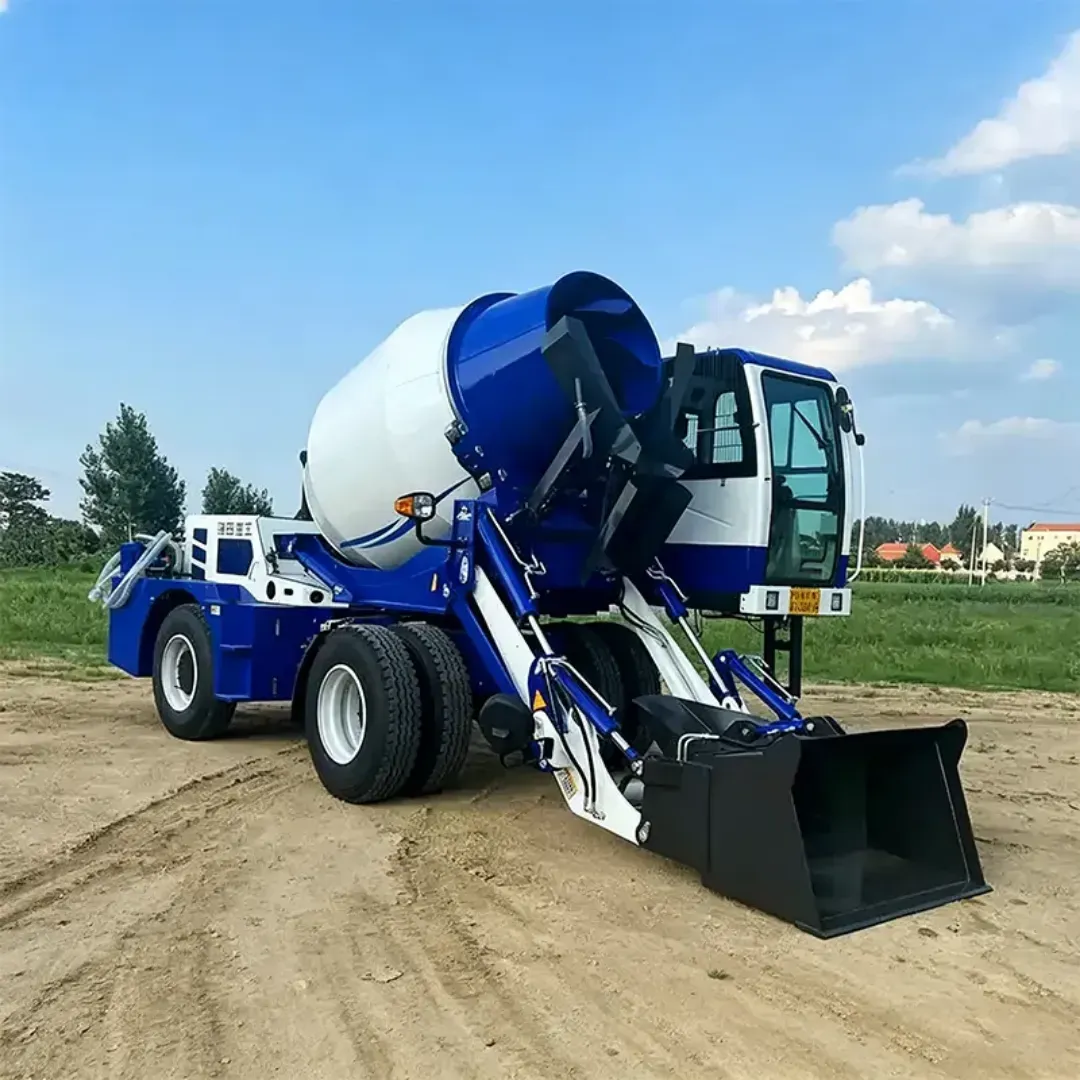
Self Loading Concrete Mixer
Scoops, batches, drives and pours — a one-man mixing crew that runs on diesel alone · 1.5–5 m³ per batch, six models
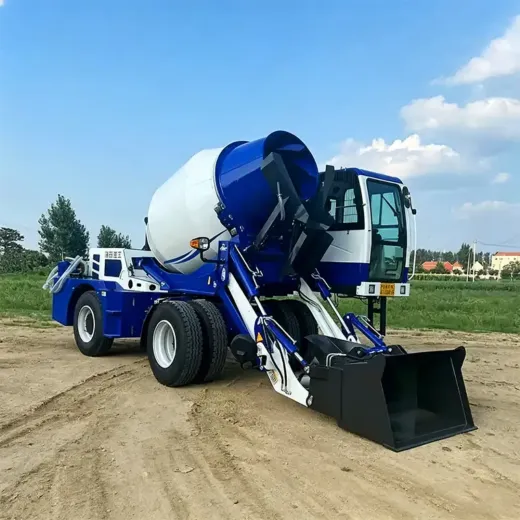
A self loading concrete mixer is a batching setup compressed onto four wheels. One operator charges the drum with the hydraulic loading bucket, the onboard water system feeds the mix, the drum agitates at 20 r/min while the machine drives at up to 35 km/h, and the batch pours straight into the formwork. We build six sizes, from a 1.5 m³ unit weighing 4,500 kg to a 5 m³ machine with a 92 kW turbo diesel. Because the entire cycle runs on diesel, this mobile concrete mixer keeps producing on sites with no grid power at all — which is exactly where most of ours end up working.
Models & technical data
| Model | Output per batch | Drum capacity | Engine | Gross weight | Dimensions (L×W×H) |
|---|---|---|---|---|---|
| 1.5 m³ class | 1.5 m³ | 1.93 m³ | Yunnei 490 turbo · 58 kW | 4,500 kg | 6,340×1,857×2,920 mm |
| 2.0 m³ class | 2 m³ | 3.45 m³ | Yunnei 4102 turbo · 76 kW | 6,600 kg | 7,040×2,695×3,001 mm |
| 2.6 m³ class | 2.6 m³ | 3.95 m³ | Yuchai 4102 turbo · 78 kW | 6,500 kg | 7,040×2,732×3,189 mm |
| 3.5 m³ class | 3.5 m³ | 5.5 m³ | Yuchai 4105/4108 turbo · 85 kW | 8,300 kg | 7,600×2,872×3,374 mm |
| 4.0 m³ class | 4 m³ | 6.64 m³ | Yuchai 4108 turbo · 91 kW | 9,000 kg | 7,850×2,872×3,374 mm |
| 5.0 m³ class | 5 m³ | 8.28 m³ | Dongfanghong/Weichai 6105 turbo · 92 kW | 10,800 kg | 8,878×3,050×3,640 mm |
Figures are from our factory parameter sheets for the six standard builds. Across the range: drum agitation 20 r/min, travel speed up to 35 km/h, loading bucket 0.55 m³ (0.75 m³ on the 5 m³ model). The 1.5 m³ unit climbs 30°; every larger model is rated 40°. Engine make can vary with supply — confirm the exact datasheet with your quote.
Watch it work
Key features
- Six models, 1.5–5 m³ per batch — from a 4.5 t compact to a 10.8 t, 92 kW machine
- Hydraulic loading bucket (0.55–0.75 m³) self-charges sand, gravel and cement — no separate wheel loader
- Drum rotates to pour on either side and keeps agitating at 20 r/min in transit
- Runs entirely on diesel — no external power supply, built for off-grid and remote sites
- Climbs 30–40° grades and travels up to 35 km/h between mixing points
- Yunnei, Yuchai and Weichai-class turbocharged diesel options, 58–92 kW
- One machine replaces a stationary mixer, a loader, two transit trucks and most of the crew
Where it works
One Machine on the Payroll Instead of Five
Price out a conventional small-pour setup: a stationary mixer, a wheel loader to feed it, two transit trucks to move the concrete, and four to six people to keep it all turning. A self loading cement truck collapses that list into one machine and one operator. The loader bucket is built in, the drum is the transport, and the pour happens off the same chassis.
The savings compound on scattered work. When pours are 2–4 m³ at a time and kilometers apart — house slabs, culvert headwalls, fence footings — transit trucks spend most of the day driving empty or waiting. A mobile concrete mixer truck batches at the sand pile, mixes on the way, and discharges exactly where the next pour is. Nothing on the cost sheet sits idle.
Be clear about the scope, though. If a project needs a continuous 60 m³/h supply to one location, that is mobile batch plant territory — a different machine class entirely. For everything below that, measured in single drumloads, the self-loader wins the arithmetic.
Built for Off-Grid Sites and Bad Roads
Most of these machines ship to Africa, Southeast Asia and Latin America, and the design assumes those conditions. There is no electrical hookup anywhere in the cycle — loading, water feed, mixing and discharge all run off the diesel engine. A village housing project, a border road camp or a mine site hours past the last power line gets the same onsite concrete mixing capability as a city contractor.
The chassis is sized for the trip, not just the site. Models from 2 m³ up are rated for 40° gradeability, and the lug-tread tires and high ground clearance handle laterite tracks, river crossings and rutted haul roads. At up to 35 km/h the machine moves itself between sites instead of waiting on a low-bed trailer.
Dust and heat are the other constants. Turbocharged Yunnei and Yuchai diesels in the 58–92 kW band are conservative, widely understood engines; filters and wear parts are stocked in most export markets, and we ship a spares recommendation matched to your region with each order.
How the Self-Loading Cycle Works
The operator drives the bucket into the aggregate pile, tips it, and the charge feeds straight into the drum mouth — 0.55 to 0.75 m³ per scoop depending on model. Cement goes in by bag or from a silo, water feeds from the onboard system, and the drum takes over from there.
Mixing happens in motion. The drum holds 20 r/min agitation while the machine drives, so a batch charged at the stockpile arrives at the formwork mixed and ready. There is no slump loss from a long transit haul and no waiting for a plant window: the concrete is made at the point of pour, minutes before it is placed.
Discharge is where a self loading concrete mixer truck earns its flexibility. The drum rotates to place concrete on either side of the chassis, into footings, columns or a pump hopper, and the machine repositions itself between pours. One unit can chase pour points around a site all day without a crane, chute extension or second vehicle.
Picking the Right Drum Size
The 1.5 and 2 m³ machines suit self-builders, farm work and village housing — pours of a slab or two per day, narrow gates, and a gross weight from 4,500 kg that ships cheaply and crosses light bridges. The 2.6 and 3.5 m³ models are the contractor's middle ground for housing estates, school and clinic projects, and rural road structures.
The 4 and 5 m³ machines are production tools. Machines in this class typically deliver in the range of 5–25 m³ per hour depending on drum size, haul distance and cycle discipline, so a 5 m³ unit running short cycles can keep a culvert or paving crew fed all shift.
If you are between sizes, tell us the typical pour volume, the haul distance and the grade of your worst access road. We build all six models in our Jining factory and will spec the drum, engine and tires against your site rather than upsell the biggest machine.
Names, Terminology and Import Paperwork
This machine goes by different names depending on the market and the person writing the RFQ — self loading mixer, mobile cement mixer, self batching concrete truck are the common ones, and all of them land on the same equipment in our catalogue: a hydraulic loading bucket on the front, a mixing drum, an onboard water system and diesel-only, four-wheel-drive operation.
The regional terms matter more for your paperwork than for ours. In francophone Africa the standard term is mixeur autochargeur; in Spanish-speaking Latin America it's autohormigonera or camión mezclador autocargable. We handle export documentation under the HS code for self-propelled concrete mixers either way — if your import permit or tender specifies a particular term, send it to us and we'll confirm the machine matches before you commit.
Mini and Small Models — Size, Weight and Price Guidance
The 1.5 m³ model is built for narrow site access, a tight budget, or modest daily pour volumes. At 4,500 kg gross weight it fits through a standard farm gate, loads into a 20-foot container alongside tooling and spares, and it's priced well below the mid-range units.
The 2 m³ class is the most popular small model in the range. It handles the same access constraints as the 1.5 m³ but batches a third more per cycle, so a house slab or culvert pour finishes faster. Both are genuine self-loading machines, not undersized curiosities — the same hydraulic charging bucket and diesel-only operation as the larger models.
Price scales with drum volume, engine displacement and options: the 1.5–2 m³ class sits at the entry end, the 2.6–3.5 m³ units step up proportionally, and the 4–5 m³ production machines carry a premium for the larger drum, heavier chassis and higher-output engine. Every quote is FOB Jining or CIF your port with no importer markup added — send us the model class and destination and we respond within 24 hours.
Pump, Trailer and Truck-Mounted Options
A self loading concrete mixer with pump is a frequent request, particularly on high-rise foundations, wall pours and any situation where the discharge chute cannot reach the formwork directly. We fit a trailer-mounted concrete pump to work alongside the self-loader on those sites: the machine discharges into the pump hopper, and the pump pushes concrete up to 80 m horizontally or 20 m vertically. The two units — self-loading mixer and pump — can be quoted together as a package.
For projects where the mixing unit needs to stay fixed and concrete is distributed by truck, we also supply a truck mounted concrete mixer configuration: a drum and hydraulic drive fitted to a customer-supplied or factory-sourced truck chassis. This format suits ready-mix delivery over short hauls where the batching already happens at a central point. It is a different machine from the self-loading unit but often requested in the same inquiry.
The mobile concrete mixer trailer — a tow-behind drum unit — rounds out the range for buyers who already own a tractor or truck and want mixing capability without a second self-propelled machine. Output, drum size and tow-hitch spec vary; quote requests for the trailer or the with-pump configuration come to the same sales team and are answered with the same 24-hour turnaround.
Mobile Ready-Mix and On-Site Batching Compared
Mobile ready mix concrete — concrete batched close to the pour rather than hauled long distances from a central plant — is what a self-loading machine produces by definition. The difference between this and a conventional ready-mix truck is that the self-loader carries no pre-batched load: it charges aggregate at the site, mixes in the drum, and delivers fresh concrete in two to four minutes. Slump, water-cement ratio and admixture dosing are controlled by the operator at the point of pour.
A truck from a fixed batch plant batches once, hauls, and returns — economics that only work within roughly 45 minutes' drive. Beyond that radius the mix degrades and the truck sits idle on the haul. A self-loading mixer eliminates the haul entirely: the machine goes to the aggregate stockpile (or the stockpile is delivered to site), batches locally, and repeats. For remote projects, island sites and locations where a ready-mix plant is hours away, the self-batching model is the only practical option.
If you're looking for a local dealer or rental unit near you, we can point you to dealers in various regions who stock machines from our range — we sell factory-direct and don't operate a rental fleet ourselves. For an export order, the factory-direct route almost always undercuts the dealer price for an equivalent or newer machine.
Related Buying Guides
Common questions
What is the self loading concrete mixer price for an export order?
We quote per order rather than from a public list, because drum size, engine choice, optional equipment and destination port move the number meaningfully. Send the model class and your nearest port and you will have a factory-direct FOB or CIF quote within 24 hours — no dealer margin in between.
What is the difference between a self loading concrete mixer truck and a transit mixer?
A transit mixer only transports — it hauls ready-mix from a batching plant and depends on one existing at the right distance. A self-loading machine is its own plant: it charges aggregate with the built-in bucket, batches, mixes in the drum and pours. Where there is no plant within economic reach, the transit truck has nothing to carry.
Do you sell used self loading concrete mixers?
No — every unit is built new in our factory. Worth checking before you buy used: a new factory-direct machine often lands close to dealer pricing for a worn one, and it arrives with a warranty, a spares kit and an engine that has never eaten bad fuel. We can also match an OEM color scheme if your fleet has one.
Can a mobile concrete mixer keep up with a small road or bridge project?
Usually, yes. Machines in this class deliver roughly 5–25 m³ per hour depending on drum size and haul distance, and most rural road structures — culverts, headwalls, short deck pours — sit comfortably inside that. For sustained large pours, run the 4 or 5 m³ model on short cycles, or tell us your daily target and we will size it honestly.
Which engines are fitted, and can I get parts locally?
The range runs Yunnei 58 kW and 76 kW units on the small models, Yuchai 78–91 kW four-cylinders in the middle of the range, and a Dongfanghong or Weichai 6105 turbo at 92 kW on the 5 m³ machine. These are common Chinese export engines, so filters, injectors and wear parts are stocked by dealers across Africa, Southeast Asia and South America.
How is the machine shipped, and what arrives with it?
Smaller models load into containers; the larger machines ship RoRo or flat rack from China's main ports, and we handle export documentation either way. Each unit leaves with its parameter sheet, an operator manual in English, a basic tool and spares kit, and the test record from our yard. Lead time is confirmed with your quote.
Can I get a self loading concrete mixer with pump included?
We can quote a trailer-mounted concrete pump alongside the self-loader as a package. The mixer discharges into the pump hopper, and the pump pushes concrete up to 80 m horizontally or 20 m vertically — useful for elevated slabs, wall pours and any pour the chute cannot reach directly. Specify your lift height and horizontal run when you enquire and we will size the pump correctly.
What is the smallest self loading concrete mixer you make?
Our entry model is the 1.5 m³ class, weighing 4,500 kg and powered by a 58 kW Yunnei turbo diesel. It fits a 20-foot container, passes through a standard gate, and suits self-builders, farms and village housing projects where daily pour volumes are modest and site access is tight. It is a full self-loading machine — not a tow-behind mixer — with the same hydraulic bucket, onboard water and diesel-only operation as the larger units.
Is a self loading mixer the same as an SLM concrete machine?
Yes — SLM is simply the trade abbreviation for self loading mixer (or self loading mobile). An SLM concrete mixer or slm concrete machine in a tender document refers to the same machine: hydraulic self-charging bucket, mixing drum, diesel engine, four-wheel chassis. Our range covers 1.5 to 5 m³ and matches any SLM specification we have encountered in export tenders.
How does a self batching concrete truck differ from a mobile batch plant?
A self batching concrete truck — another name for a self loading mixer — batches one drum at a time in a compact, self-propelled unit. A mobile batch plant is a larger installation (often trailer-mounted) that feeds multiple transit trucks at higher hourly output. The self-loader wins on mobility, simplicity and cost for projects below roughly 30 m³/h; the batch plant wins on sustained high-volume supply to a fixed pour. If you describe your project we will tell you honestly which fits.
Do you offer a mobile concrete mixer trailer or truck-mounted drum?
Yes to both. A tow-behind mobile concrete mixer trailer suits buyers who already own a tractor or truck and want mixing capability without a second self-propelled machine. A truck mounted concrete mixer fits a drum and hydraulic drive to a truck chassis for short-haul ready-mix delivery. Both are different products from the self-loading mixer and are quoted separately — send your chassis spec or intended tow vehicle and we will match the drum.
Request pricing for the Self Loading Concrete Mixer
Send your target model, quantity and destination port. Our export team replies within one business day with a quote, lead time and shipping details.
- Phone / WhatsApp: +86 182 5478 8200
- Email: [email protected]
- Jining, Shandong, China