









ZM-35 Rough Terrain Forklift
Four driven wheels, lug tires and a straight mast — built for the ground your concrete floor ends at · 3.5 t 4×4 off-road forklift
The ZM-35 is a 3.5-ton rough terrain forklift built around one job: lifting banded, crated and bagged loads on ground a smooth-tire machine won't touch. A 42 kW engine drives all four wheels through 20.5/70-16 lugged tires, so it keeps traction in mud, on loose gravel and up wet slopes. The 2250 mm wheelbase is long enough for stability under a raised load, short enough to turn around in a crowded yard. Construction crews, timber yards, farms and oil-field service companies run this class of 4x4 forklift where a paved-floor truck simply digs in and stalls. Rated capacity is 3500 kg, with custom ratings on request.
Models & technical data
| Item | ZM-35 |
|---|---|
| Rated load capacity | 3500 kg (custom ratings available) |
| Drive type | 4×4 — all four wheels driven |
| Engine power | 42 kW |
| Wheelbase | 2250 mm |
| Mast tilt (front / rear) | 10° / 12° |
| Service brake | Hydraulic |
| Tires | 20.5/70-16 off-road lug tread |
| Lift height | 3,000 mm (3–4.5 m mast options) |
| Engine model | Weichai/Weifang 4108, 42 kW |
| Overall dimensions (L×W×H) | 3,580×1,760×2,420 mm (mast lowered) |
| Travel speed | 20 km/h |
| Gradeability | 20% (laden) |
Figures below are taken from the ZM-35 factory parameter sheet. Mast height, attachments and final dimensions are configured per order — the values shown are the standard build, confirmed on the full datasheet with your quote.
Watch it work
Key features
- 3500 kg rated capacity on a 2250 mm wheelbase — stable under load on uneven ground
- 42 kW engine with 4×4 drive keeps all four wheels pulling through mud, sand and crushed rock
- 20.5/70-16 wide-lug off-road tires bite into soft ground instead of spinning
- Mast tilts 10° forward and 12° back to keep loads cradled on slopes
- Thickened forged forks and a reinforced mast for shock loads from rough terrain
- Enclosed glass cab with clear sightlines to the fork tips; hydraulic service brakes
- OEM color and logo customization available for dealers and fleet buyers
Where it works
What Makes a Rough Terrain Forklift Different
A standard counterbalance truck rides on small cushion tires and expects flat concrete. The ZM-35 takes the opposite approach: 20.5/70-16 lug tires, a high-clearance chassis and a 42 kW engine sending torque to all four wheels. On wet clay or crushed rock the tread bites instead of spinning, and the operator keeps moving instead of waiting for a tow.
Stability comes from geometry, not electronics. The 2250 mm wheelbase spreads the load over a long footprint, and the mast tilts 10 degrees forward for picking and 12 degrees back to cradle the load while climbing. Hydraulic service brakes hold the machine on grades. The forks are thickened forgings, and the mast is reinforced to take the shock loads rough ground feeds back into the frame.
One distinction worth knowing before you compare quotes: a rough terrain telehandler is a different machine with a telescopic boom, and we don't build those. The ZM-35 is a straight mast rough terrain forklift — simpler, cheaper to maintain, and it lifts close to the chassis where the load rating stays honest.
Where the ZM-35 Earns Its Keep
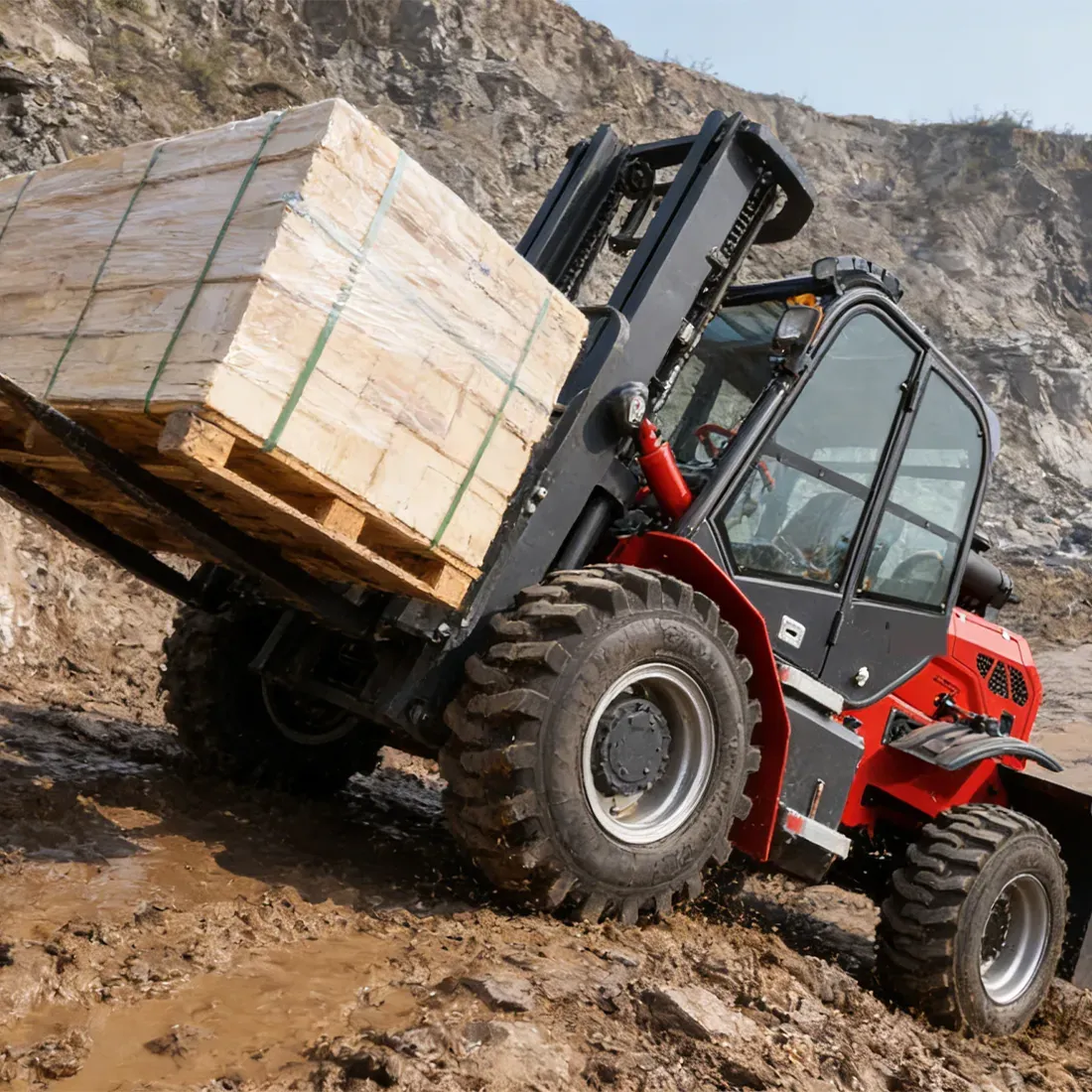
On building sites it moves scaffolding sections, block and bagged cement across ground that excavators and rain have already churned up. The photos on this page are working machines, not studio renders — one of them is lifting a scaffold tower in the rain on a flooded slab yard, which is a fair picture of the job.
Timber yards run this class of 4wd forklift between log stacks on dirt lots, and farms use it to shift feed, fertilizer and produce bins across fields and unpaved barn lots. An outdoor forklift lives in the weather, so the enclosed cab, mirrors and wiper are standard equipment rather than options.
In quarries and on oil-field pads the ZM-35 carries rock boxes, drill pipe and spares over crushed stone. For loose material there is a bucket attachment in place of the forks — useful when the same machine has to load gravel in the morning and stack crates in the afternoon.
Buying Direct from the Factory
We build and export the ZM-35 from Jining, Shandong, and sell factory direct — no trading-company margin between you and the people who weld the frames. Dealers can order machines in their own color scheme with OEM logo support; the red-and-black livery in the photos is simply our standard finish.
Every machine we quote is priced against your actual duty: tell us the loads you lift, the ground you run on and the port you need. We respond with a configured build sheet — mast height, attachment and capacity options included — rather than a one-size price list.
Straight-Mast Forklifts vs. Telehandlers vs. Articulated Trucks
The ZM-35 is a straight-mast machine: the mast rises vertically in front of the chassis, and the fork tips stay close to the machine's centerline through the full lift. That geometry keeps the rated capacity honest at any height — what you see on the spec sheet at ground level still holds true at the top of the mast. It's also the simplest mast design to service: fewer hydraulic cylinders, fewer wear points, less to go wrong on a site with no dealer nearby.
A telehandler does the same basic job — moving a load on uneven ground — with a boom that extends forward and outward instead of a mast that goes straight up. That added reach comes from a more complex hydraulic and structural package, which is why telehandlers cost more to buy and maintain. We don't build telehandlers; if your job is setting a load over a wall or into a rack from a fixed position, you want one. If your job is stacking pallets, timber or bagged material on broken ground, the straight-mast ZM-35 does it for less money and less downtime.
The third layout worth knowing is the articulated forklift, which bends at the center of the chassis instead of steering through the rear wheels. That gives it a tighter turning circle in a confined yard. The ZM-35 uses conventional rear-wheel steering instead — the same steering behavior as a warehouse forklift, so operators coming off indoor equipment adapt to it immediately, and any forklift mechanic can service it without retraining.
Size and Capacity Range
Rough terrain forklifts span a wide capacity range. At the compact end, machines rated under roughly 2,500 kg are sized for tight sites and smaller budgets — landscape contractors, small farms and yards where a full-size machine is too wide to maneuver. At the top of the range, builds up toward 4.5 t (about 10,000 lb) handle steel coils, precast panels and heavier machinery on outdoor pads.
The ZM-35 sits in the mid-size class at 3,500 kg (about 8,000 lb), which covers the bulk of construction-site and timber-yard work — banded lumber, block cubes, bagged cement and equipment crates. Custom ratings above or below the standard range are available; tell us your load, your terrain and your required lift height and we'll quote the build that fits the job.
Mast Types and Attachments
The ZM-35 ships as a straight mast, in heights from 3 m to 4.5 m depending on the build. That geometry keeps the tipping threshold predictable and the rated capacity honest at every lift height. For jobs that need to place loads over obstacles or reach beyond the chassis, a telescopic-boom alternative is available on inquiry — a different drivetrain and price point, built for a different task.
A range of attachments extends what one machine can do on site. Side-shift lets the operator align forks without repositioning the truck — useful when stacking on uneven ground. A bucket attachment turns the ZM-35 into a material handler for gravel, aggregate or loose product. Pipe clamps, bale clamps and a rotator cover specialized loads, and a jib boom option adds the reach to set loads over edge beams in precast and structural steel work. Every attachment carries a de-rate factor, listed on the build sheet, so the capacity rating stays accurate once it's fitted.
Drive is genuine 4×4: power goes to all four wheels at all times, not just to one axle with the second along for the ride. That's what keeps the machine pulling in mud, sand and crushed rock instead of spinning a single wheel and stopping.
What Factory-Direct Actually Buys You
The ZM-35 is built and quality-checked at our own plant in Jining — welded frames, mast assembly and final test all happen under one roof, with the same crew responsible for the machine from raw steel to test-lift. Buying factory-direct doesn't mean buying a lesser machine; it means removing the trading-company and distributor margin that sits between the factory and a buyer sourcing through a domestic dealer network.
Buyers sourcing this class of machine commonly benchmark against established brands like Pettibone, Sellick or Lull — and that's a fair comparison to make. The real difference is landed cost, not build quality: a machine shipped CIF from Jining costs substantially less delivered than the same-spec machine sold through a North American distributor. We back every export order with a warranty, a spare-parts pack shipped with the machine, and English technical documentation, so the support gap that used to come with buying overseas is largely closed.
Buying Guide: What to Specify Before You Request a Quote
Listings for this class of machine span a wide range — from compact units under 2 t up to 10,000 lb builds. Before contacting any supplier — including us — lock down four numbers: (1) rated load in kg or lb, (2) lift height in mm or feet, (3) terrain type (firm gravel, soft clay, slope angle), and (4) power source preference (diesel is standard; LPG is available for indoor/outdoor mixed use). With those four inputs any manufacturer can quote a real machine rather than a catalog average.
Second, decide between a straight mast and a telescopic configuration. A rough terrain counterbalance forklift with a straight mast is cheaper to buy, simpler to maintain and rates capacity honestly. Variable reach rough terrain forklifts and rough terrain telehandler forklift builds cost more and suit different jobs — placing loads over walls or out from a loading dock, not simply stacking pallets on broken ground. Most buyers comparing rough terrain forks for a construction yard or a farm need the straight-mast, counterbalanced design.
Third, check whether you are buying new or used. To buy rough terrain forklift equipment used, the key service items to inspect are the mast channels, the differential seals, the lug-tire wear and the hour meter. A 4wd rough terrain forklift with worn differential seals will lose traction exactly when it is needed most. On a new machine, confirm the warranty terms, spare-parts availability and lead time from the rough terrain forklift manufacturers you shortlist. We ship in standard sea containers, include a spare-parts pack and provide English technical documentation for every export order.
Related Buying Guides
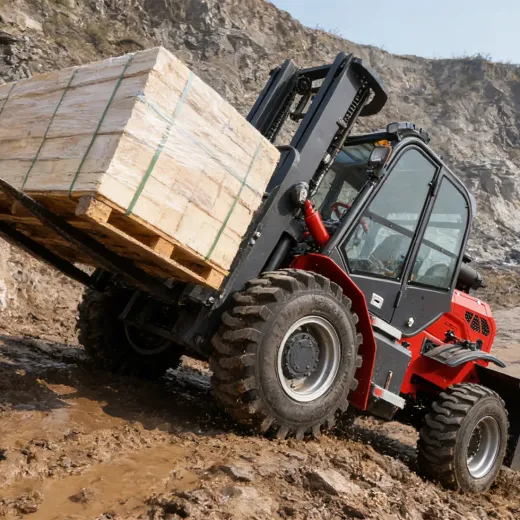
When You Need a Rough Terrain Forklift (and When You Don't)
A rough terrain forklift earns its keep outdoors on dirt, mud and grades where a warehouse truck is stranded. Here's how to know if you need the best rough terrain forklift — and when a standard one will do.
Read more →
Forklift Wheels & Tires: Types, Sizes, and When to Replace
A complete guide to forklift wheels and tires: cushion, pneumatic, solid, and polyurethane types explained, how to read size markings, wear indicators to watch, and when replacement is overdue. Covers electric forklifts and rough-terrain machines.
Read more →Common questions
What can a 3.5 ton rough terrain forklift truck handle day to day?
The ZM-35 is rated 3500 kg, which covers most banded timber packs, block cubes, bagged cement and equipment crates moved on job sites. The 42 kW engine and 2250 mm wheelbase are matched to that rating, so the machine works at capacity on dirt rather than only on paper. Heavier ratings can be built on request.
Is a 4x4 forklift worth it for a farm or timber yard?
If any part of your route is dirt, grass or gravel, yes. A two-wheel-drive yard truck loses traction the first wet week of the year, and a stuck machine costs more in downtime than the price gap. The ZM-35's four driven wheels and lug tires are the difference between working through mud season and parking through it.
Can a 4wd forklift climb slopes with a full load?
The ZM-35 climbs with the mast tilted back 12 degrees so the load stays cradled, and hydraulic service brakes hold it on the grade. Exact gradeability depends on the surface, the load and the build configuration, so we state it on the datasheet for your spec rather than quoting one number for every condition.
Do you have a rough terrain forklift for sale with custom capacity or color?
Yes. The standard ZM-35 is rated 3500 kg, and the factory sheet lists custom load ratings on request. Dealers and fleet buyers can also specify their own paint color and OEM logo. Send the capacity, mast height and market you need, and we will quote the matching build with lead time.
Will it hold up as an outdoor forklift in rain and mud?
That is the machine's natural habitat. The enclosed glass cab keeps the operator dry, the 20.5/70-16 lug tires keep their grip on soaked ground, and the high-clearance chassis stays out of the ruts. It is designed to be parked outside and worked in weather that sends warehouse trucks indoors.
What is the difference between an all terrain forklift and a rough terrain telehandler?
Both work on unpaved ground, but the lift geometry is different. A straight-mast machine like the ZM-35 uses a vertical mast and counterbalanced chassis — it lifts loads directly in front of the machine, close to the chassis, so the rated capacity stays honest at any lift height. A telehandler extends a boom outward and upward instead, giving variable reach but adding mechanical complexity and a higher purchase price. If your job is stacking banded pallets, timber or bags on a construction site or farm, the straight-mast design handles it at lower cost. If you need to place loads over walls or into storage racks from a fixed position, you need a telehandler.
What attachments can I fit to a rough terrain forklift?
The most common attachments are side-shift (for fine fork positioning without moving the truck), a bucket (converting the machine to a material handler for aggregate or grain), pipe and bale clamps (for bundled pipe and round stock on oil-field pads), and a jib boom for setting loads over edge beams or into trenches. Every attachment carries a de-rate factor that reduces the rated capacity; we list the de-rated capacity on the build sheet so there are no surprises on site.
How does the ZM-35 compare to Pettibone, Sellick or Lull rough terrain forklifts?
Pettibone rough terrain forklift, Sellick rough terrain forklift and Lull rough terrain forklift machines are established North American brands with a wide dealer network and high parts availability locally. The ZM-35 delivers a comparable rated capacity and 4×4 drive specification at a significantly lower CIF landed cost, which makes it attractive for buyers who can source parts via us or through a local import agent. The trade-off is lead time (sea freight vs. domestic dealer stock) and the fact that local mechanics may be less familiar with the machine on first service. We include English technical documentation and a spare-parts pack with every export order to reduce that gap.
Can I get a small or mini rough terrain forklift in a lighter capacity?
Yes. We build compact variants below the ZM-35's 3,500 kg rating, in the 2.5–3 t range. These are narrower and lighter, making them suitable for tighter site access. Contact us with your load, lift height and site width and we will confirm whether a compact build fits your duty or whether the ZM-35 standard frame is more appropriate.
What power source options are available for an off road fork truck?
The ZM-35 is diesel as standard, which is the right choice for outdoor-only operation with no emission controls on site. LPG (propane) is available for buyers who run the machine in mixed indoor/outdoor environments — the same sealed chassis and 4×4 drivetrain, with a propane tank in place of the diesel tank. Electric is not offered in the rough terrain class: battery weight, ground clearance and waterproofing requirements make it impractical for genuine off-road work at this capacity.
Is there a walk-behind or 3-wheel version of a rough terrain forklift?
Walk behind all terrain forklift and 3 wheel off road forklift are niche configurations — typically for very light loads (under 1 t) in narrow or steeply pitched spaces. We do not build those; the ZM-35 is a full ride-on, four-wheel machine. If you need a very compact, lightweight rough terrain lift, note that most true rough terrain counterbalance forklifts are ride-on by design: the counterweight mass needed to balance a load on uneven ground makes a walk-behind impractical above about 500 kg.
How do I buy a rough terrain forklift and what is the process?
The process is straightforward. Send us your four key specs — load (kg or lb), lift height, terrain type and power preference. We respond with a configured build sheet and FOB/CIF price within one business day. Once you confirm the spec and deposit, production takes 25–35 days; sea freight adds 18–35 days depending on your port. We handle the export documentation, CE or other certifications as required for your market, and provide an English parts and service manual with every machine. The same process applies for lighter-capacity builds — just tell us your load.
Request pricing for the ZM-35 Rough Terrain Forklift
Send your target model, quantity and destination port. Our export team replies within one business day with a quote, lead time and shipping details.
- Phone / WhatsApp: +86 182 5478 8200
- Email: [email protected]
- Jining, Shandong, China